
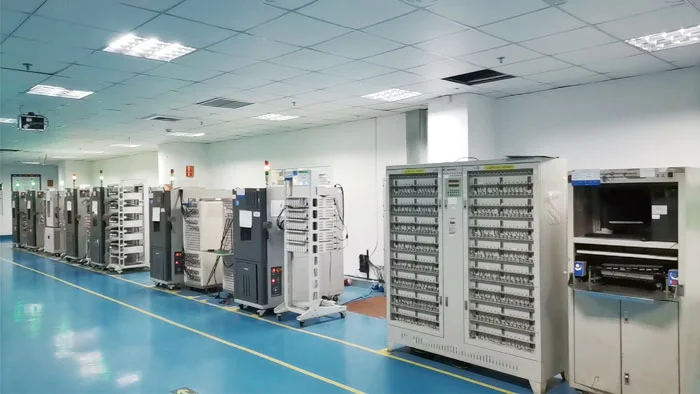
Battery system reliability depends on a sequence of control operations rather than one final inspection. A deviation missed at component level becomes more difficult and costly to correct after complete battery assembly.
Incoming inspection
Control begins with battery cells, BMS electronics, power components, sensors, cables, and enclosure parts. Cell voltage, internal resistance, capacity, and batch consistency are especially important.
Components with closely matched characteristics create a more balanced module. This reduces balancing demand and supports stable operation throughout battery life.
Control during assembly
Production checks cover mechanical connections, tightening torque, insulation, cable routing, and temperature sensor placement. Automated operations improve repeatability but do not replace functional inspection.
After BMS connection, testing covers:
- voltage readings for each cell group;
- temperature measurement channels;
- contactor and protection control;
- communication through supported protocols;
- response to simulated abnormal conditions.
Complete system verification
The assembled module undergoes controlled charge and discharge cycles. Engineers evaluate available capacity, temperature rise, voltage stability, and BMS reporting accuracy.
Protected models also require enclosure sealing and temperature system checks. Test results are linked to serial data to provide product traceability.
Why the process matters more than one test
A final test confirms the condition of one unit, while consistent production quality requires a controlled process. Incoming specifications, standardized assembly, calibrated equipment, and result analysis reveal trends before they become field failures.